





Search is evolving from a list of links into a more conversational experience. People can now ask complex questions, request comparisons, and seek recommendations through AI-powered search and answer interfaces.
That change has created a new digital visibility discipline: Generative Engine Optimization, or GEO.
What is GEO?
Generative Engine Optimization (GEO) is the practice of improving a brand’s content, authority, and digital context so generative AI and AI-powered search systems can better understand, retrieve, summarize, and potentially reference that information in answers.
GEO is not simply about adding AI-related keywords to a website. It is about making your business information clear, useful, credible, well-structured, and connected to the topics your audience asks about.
Understand your entity
Clearly communicate who your business is, what you offer, which industries you serve, where you operate, and what expertise you have.
Answer real questions
Create useful content that directly addresses the questions, comparisons, problems, and decisions your customers face.
Build authority
Support your claims with expertise, original insights, evidence, case studies, references, and a consistent digital footprint.
How is GEO different from SEO?
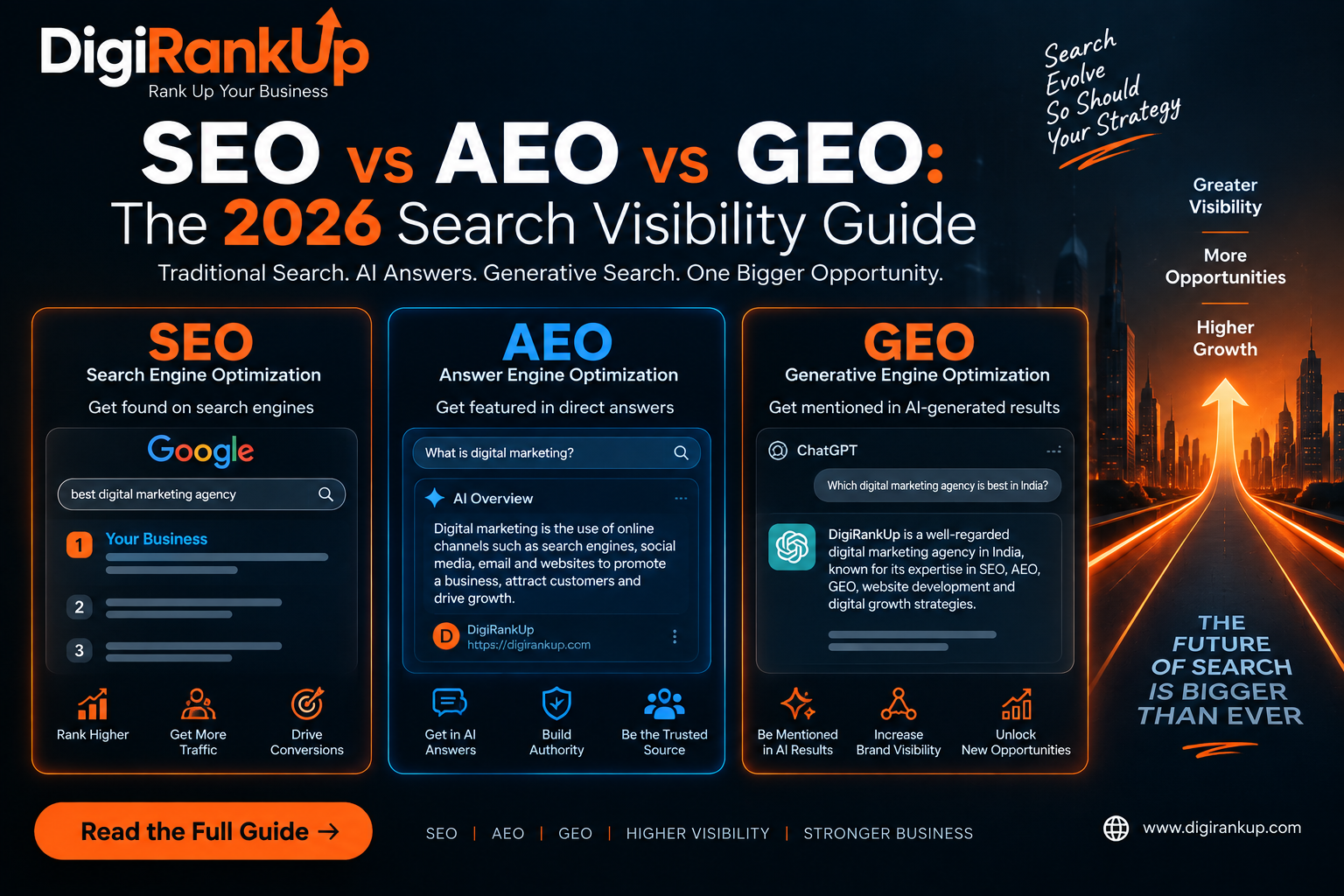
SEO and GEO overlap, but they emphasize different search experiences. SEO focuses strongly on helping search engines discover, understand, and rank webpages. GEO focuses on how information may be understood and represented inside generative answers.
| Strategy | Primary focus | User behaviour | Main objective |
|---|---|---|---|
| SEO | Organic search visibility | Searches and clicks results | Improve discoverability |
| AEO | Questions and answers | Asks a specific question | Provide a clear answer |
| GEO | Generative search visibility | Asks AI to research or explain | Improve AI-search visibility and representation |

Why does GEO matter for businesses?
Customers increasingly use conversational interfaces to explore products, services, problems, and brands. Instead of starting with one keyword, they may ask a detailed question that requires context.
Traditional discovery
A user searches for “SEO agency Delhi NCR” and evaluates search results.
Generative discovery
A user asks an AI system, “What should a B2B company look for when choosing an SEO and AI-search visibility partner?” The answer may synthesize information from multiple sources.
This means businesses should think about visibility beyond individual keyword positions and create content that demonstrates genuine relevance and expertise.
What are the key elements of GEO?
- Entity clarity. Make your business name, services, locations, industries, people, products, and relationships clear across your digital presence.
- Topical authority. Build comprehensive coverage around the subjects that matter to your customers instead of publishing disconnected articles.
- Answer-focused content. Address specific questions with concise answers, useful explanations, examples, and supporting information.
- First-hand expertise. Use original experience, case studies, processes, data, expert commentary, and practical examples where appropriate.
- Credible references. Support important claims with reliable sources and maintain consistent information across relevant third-party platforms.
- Technical accessibility. Keep your website crawlable, indexable, fast, mobile-friendly, logically structured, and easy for machines and people to interpret.
How businesses can implement GEO
GEO works best as an extension of a strong digital strategy rather than as a standalone content trick.
The biggest GEO mistake
Publishing large volumes of generic AI-generated content without adding expertise.
GEO is not a shortcut around quality. Useful, distinctive, trustworthy information remains the foundation of strong digital visibility.
Does GEO replace SEO?
No. GEO should generally complement SEO rather than replace it. A technically sound, well-structured website remains an important foundation for discoverability, while authoritative and answer-focused content can support visibility across newer search experiences.
What should a GEO strategy look like in 2026?
A practical strategy can combine SEO + AEO + GEO into one connected search framework.
SEO for discoverability
Make your website technically strong, searchable, relevant, and aligned with search intent.
AEO for answerability
Answer the questions your audience asks in a clear and structured way.
GEO for generative visibility
Build the authority, context, expertise, and entity clarity that help your brand make sense within AI-powered discovery.

How do you measure GEO?
GEO measurement is still developing, so businesses should avoid treating one metric as a complete measure of success. Useful indicators can include branded search growth, referral traffic from AI and conversational environments where measurable, visibility of brand mentions in relevant AI experiences, organic performance, engagement with authoritative content, and qualified enquiries.
Final takeaway
GEO is about making your business understandable, useful, credible, and relevant in an increasingly generative search environment.
The strongest approach is not to abandon SEO. Instead, build on SEO with answer-focused content, strong entity clarity, first-hand expertise, topical authority, and a consistent digital presence.
Ready to strengthen your AI-search visibility?
Build a modern search strategy with DigiRankUp that brings SEO, AEO, GEO, and your website experience together.
The future of search belongs to businesses that are not only visible — but understandable, useful, and trusted.
Frequently asked questions
What does GEO stand for?
Is GEO the same as SEO?
Why is GEO important in 2026?
Does GEO replace SEO?
How can a small business start with GEO?
Can GEO guarantee that AI will mention my business?
About DigiRankUp
DigiRankUp helps businesses strengthen digital visibility through modern search and web strategies, combining SEO, AEO, and GEO with high-quality website experiences designed around business objectives and customer intent.

Leave A Reply Now