


By Sharad Narayan, Founder, DigiRankUp · Last updated 26 November 2026

Your customers still search on Google. But more and more of them now ask ChatGPT, Gemini or Google’s AI answers a full question, like “which law firm in Sydney handles small business disputes?”, and get a short list of names back.
If your business is not in that answer, you lose the customer before they ever see your website. AI SEO is how you get into that answer. This guide explains what it is, why it matters and exactly how to start.
Key takeaways
AI SEO (AI search optimisation) means optimising your website and online presence so that AI-powered search tools, such as ChatGPT, Google AI Overviews, Google AI Mode, Gemini, Perplexity and Microsoft Copilot, can find your content, understand what your business does, and choose to mention or cite you.
It combines three layers:
| Layer | Goal | Where it shows |
|---|---|---|
| SEO | Rank in Google and Bing | Classic search results |
| AEO (Answer Engine Optimization) | Be quoted as the direct answer | AI Overviews, featured snippets, voice |
| GEO (Generative Engine Optimization) | Be named and recommended | ChatGPT, Gemini, Perplexity, Copilot, AI Mode |
Note: “AI SEO” is also used for using AI tools to do SEO work. This guide is about the bigger shift: getting your business found in AI search. For a deeper comparison, read SEO vs AEO vs GEO.
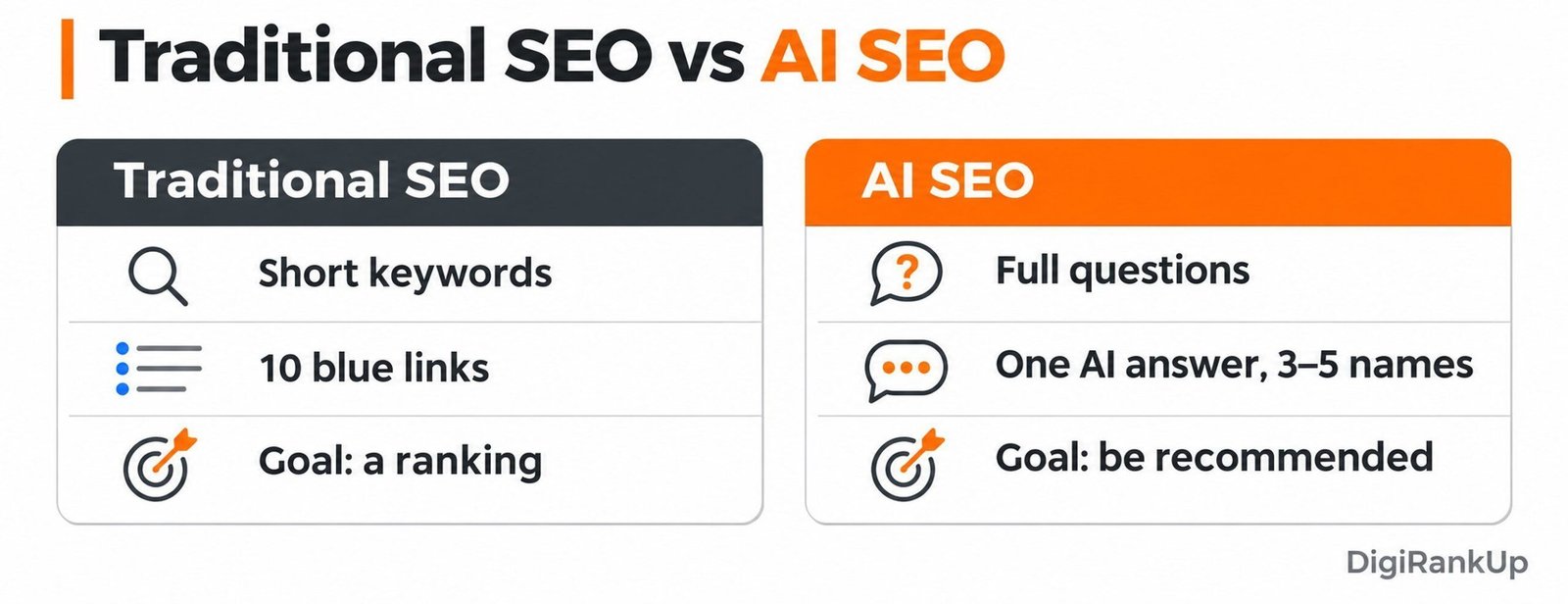
| Traditional SEO | AI SEO | |
|---|---|---|
| Target | A ranking position | A mention or citation in an answer |
| Query style | Short keywords | Full questions with budget, location or size |
| What wins | Relevance, links, technical health | All of that, plus clear answers, entity clarity and trust |
| Result | Ten blue links | One written answer naming a few sources |
| Measured by | Rankings, clicks | AI mentions, citations, share of voice, plus rankings |
The good news: AI SEO does not replace SEO. AI tools still lean on pages that are crawlable, indexed and trusted, so strong SEO is the foundation.
AI search tools do not publish a ranking formula, but their makers’ public guidance and the way answers behave point to the same five signals:
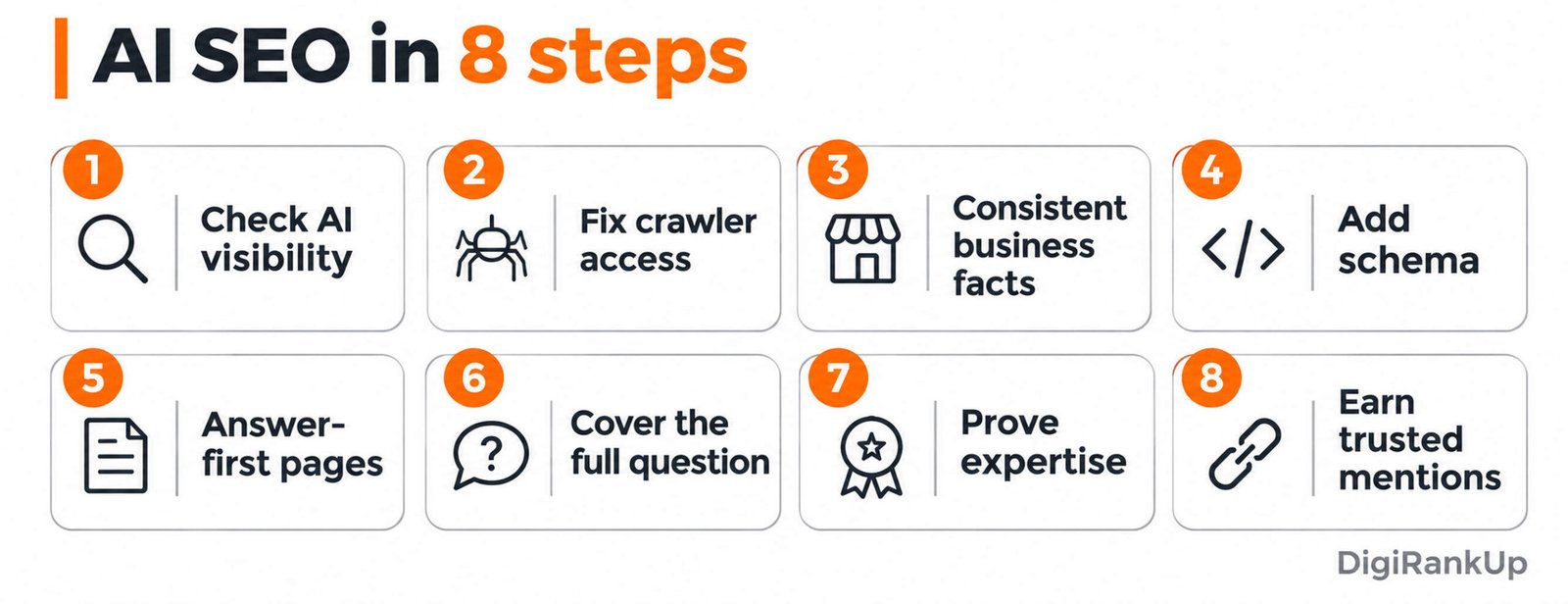
Want a head start? Our free AI Visibility Audit covers step 1 for you.
The scenarios below are illustrative examples, not client case studies. They show how AI search queries work in each market.
A small business owner in Texas asks ChatGPT: “Which business litigation lawyers in Dallas handle disputes under $500,000?” AI favours firms whose pages state practice areas, case types, fee approach and attorney credentials clearly. A firm with only a generic “We fight for you” homepage is easy to skip.
A parent in Melbourne asks Google AI Mode: “Which dentist in Richmond does Invisalign for teens and has weekend hours?” Clinics that list treatments, opening hours, suburbs served and real reviews on their site and Google profile are far more likely to be named.
A procurement manager in Germany asks Perplexity: “Which Japanese suppliers make precision bearings for medical devices with ISO 13485?” Manufacturers with English product pages, clear certifications, specifications and export details are the ones AI can confirm and cite.
A finance director asks: “What is the best invoicing software for a 50-person UK agency that integrates with Xero?” AI picks products whose pages spell out integrations, pricing tiers, ideal company size and comparisons.
A buyer asks: “Best CNC machine suppliers in Faridabad for small batches.” Suppliers with detailed product pages, capacity, certifications and consistent listings have the edge.
The pattern is the same everywhere: AI recommends businesses whose websites answer specific buyer questions with verifiable facts.
AI SEO is optimising your website so AI search tools like ChatGPT and Google AI Overviews can understand your business and recommend it when people ask questions.
Yes. Traditional SEO aims for Google rankings. AI SEO also aims for mentions and citations inside AI answers, using AEO and GEO on top of SEO.
Technical fixes take effect in weeks. Mentions in AI answers usually improve within 2–4 months, depending on competition and your current authority.
No. AI tools choose answers themselves. AI SEO improves the signals they rely on and tracks mentions, but no honest provider can guarantee placement.
Yes. AI answers often surface specific, well-explained pages, so a small business with clear, honest pages can beat larger competitors with vague ones.
Yes. AI search tools are used worldwide and the same principles apply in every market. Local details like currency, location and regulations should match the target country.
AI search has changed how customers find businesses. They ask full questions and trust the short list AI gives them. AI SEO puts your business on that list by making your website clear, specific, trusted and easy for machines to read. Start with a visibility check, fix the basics, and build answer-first content around your buyers’ real questions.
Find out what ChatGPT and Google AI say about your business
Get a free AI Visibility Audit with a score out of 100 and a 30-day action plan, or explore our AI SEO services.
About the author
Sharad Narayan is the founder of DigiRankUp, a digital growth agency based in Faridabad, Haryana. He helps business owners, SMEs and B2B companies in India and worldwide grow through SEO, AEO and GEO, website design and portal development, with a focus on turning search and AI visibility into qualified enquiries.
Further reading