


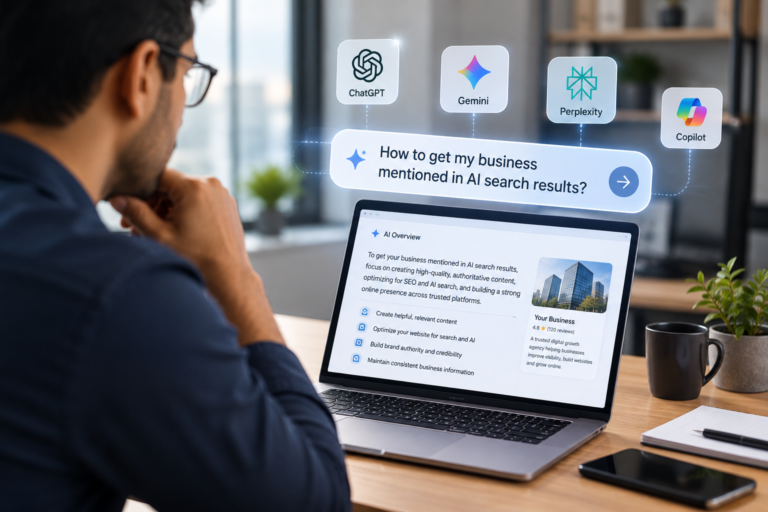
To improve your chances of being mentioned in AI search results, make your business information easy to discover, verify and understand. Build a technically accessible website, explain your services clearly, publish original evidence-backed content, earn credible references and answer the questions your customers actually ask.
These steps can strengthen visibility across AI-assisted discovery, but they cannot guarantee that ChatGPT, Google AI or Microsoft Copilot will mention or cite your business.
Updated: November 2026 | DigiRankUp editorial guide
AI search systems can only use information they can access and interpret, and every platform has its own crawling, indexing and retrieval processes. Start with your technical foundations, make your brand and offers unambiguous, publish information that adds real value, support claims with evidence and keep the website current.
Think of a mention, a citation, a website visit and a qualified lead as four different outcomes. Measure each one separately.
An AI-search mention occurs when an AI-powered search or answer experience refers to your business, product, service or brand in response to a user’s question. The system may name your business directly, link to one of your pages, or use information from your website while producing a broader answer.
These outcomes should not be treated as interchangeable. A business name appearing in an answer is a mention; a page shown as a source is a citation; a user visiting the website is a referral; and a relevant enquiry is a business outcome.
| Outcome | What it tells you | How to measure it |
|---|---|---|
| Mention | Your brand is named in an AI response | Consistent prompt testing and monitoring |
| Citation | Your website is shown as a source | Platform citation reporting where available |
| Referral | A user visits your site from an AI experience | GA4 referral / campaign attribution |
| Qualified lead | A relevant prospect contacts your business | Forms, calls, CRM and sales qualification |
A citation does not automatically produce a click, and a click does not automatically become a lead. Some AI answers may summarize information without a visible source link. A useful GEO programme therefore tracks visibility, referral behaviour and commercial outcomes as separate parts of the customer journey.
For a broader explanation of how SEO, AEO and GEO work together, read SEO vs AEO vs GEO: differences, examples and strategy.
There is no single AI-search crawler or one universal inclusion switch. Google Search, ChatGPT Search and Microsoft Copilot have their own systems, controls and reporting. Make decisions using the documentation for the platform you want to appear in.
Google’s guidance says the foundational SEO practices remain relevant for generative AI features: pages need to be accessible and eligible for Search, and content should be unique, useful, reliable and people-first. Google also says there is no special llms.txt requirement, no ideal content-chunk size and no special schema markup required for AI Search. Its Search Console Generative AI performance report can help eligible site owners measure discovery through supported AI features.
OpenAI identifies OAI-SearchBot as the crawler used to surface websites in ChatGPT Search. OpenAI says site owners can manage OAI-SearchBot independently from GPTBot, which is used to crawl content that may be used to train foundation models. Allowing OAI-SearchBot is relevant to Search discovery; it is not a guarantee of being mentioned.
Bing Webmaster Tools’ AI Performance report shows cited URLs, citation activity over time and grounding-query patterns across supported Microsoft AI experiences. Bing explicitly notes that these aggregated citations are not rankings, traffic or a quality score. The report is useful for understanding which pages are referenced, not for claiming a specific content change caused a citation increase.
The strongest approach is to improve the information environment around your business. Start with the foundations, then make your most important service and product pages genuinely useful to the people and organizations you want to reach.
Check that important pages return a successful response, are internally linked and are not accidentally blocked by robots.txt, noindex directives, login walls or firewall rules. Confirm that canonical URLs point to the preferred page, the XML sitemap is current and mobile rendering exposes the main content.
For ChatGPT Search, review the OAI-SearchBot rule separately from GPTBot. OpenAI recommends allowing OAI-SearchBot for ChatGPT Search visibility and allowing requests from its published IP ranges. If you use a CDN or web application firewall, verify that legitimate crawler requests are not being challenged or blocked.
Make your business name, core services, products, markets, locations, industries served and contact information easy to find. Your About page, service pages, contact page and relevant company profiles should describe the same organization consistently. Avoid vague descriptions that make it difficult to understand whether you are an agency, manufacturer, software provider or consultant.
Where relevant, identify authors and subject-matter experts, explain their role and connect their work to the topics they cover. Do not invent credentials, awards or years of experience.
A service page should explain who the service is for, what is included, the problems it addresses, how the process works, what information a buyer needs before choosing a provider and how to make contact. Product pages should provide accurate specifications, use cases, compatibility information, limitations and supporting documentation where relevant.
Do not expect an AI system to infer your expertise from a short headline or a list of keywords. State the useful facts clearly on the page.
Build a question map from sales conversations, customer support requests, search queries, proposal objections and competitor comparisons. Group questions by intent: learning, troubleshooting, comparison, supplier evaluation and purchase readiness. Prioritize high-value topics that align with your actual services instead of creating a separate page for every possible prompt variation.
Give readers information they cannot get from a generic rewrite: first-hand processes, original analysis, expert commentary, useful examples, relevant documentation, product tests or properly contextualized data. When you present a case study, identify what was measured and what changed. Label hypothetical examples clearly. Support material factual claims with reliable sources.
Google specifically encourages unique, non-commodity content that provides value beyond common knowledge. Adding volume without adding expertise is not a sustainable GEO strategy.
Organize related pages around a clear subject. A core guide can link to deeper supporting articles, comparison pages, FAQs, case studies and service pages. Use descriptive internal-link text and link only when the destination genuinely helps the reader continue their research.
For DigiRankUp’s AI-search topic cluster, connect this guide to what GEO means, 10 steps to improve ChatGPT visibility and how to improve a website’s chances of appearing in ChatGPT.
Build recognition through legitimate industry publications, relevant trade associations, expert interviews, useful partnerships, credible customer references and original research that others may cite. Keep profiles accurate and make it easy to verify what the business does.
Avoid buying batches of low-quality links, fabricated reviews, automated forum mentions or mass-produced guest posts. Google explicitly warns against seeking inauthentic mentions as a way to influence generative Search. Aim for references that a real customer would trust.
Use appropriate structured data when it accurately describes visible page content, such as Organization, Article, BreadcrumbList or relevant product information. Check that the markup matches the page and validate it. Use meaningful headings, lists, descriptive tables, image alt text and accessible navigation because they help people understand the content too.
Do not assume that llms.txt, special GEO schema, artificial content chunking or FAQ markup will make an AI system cite your page. Google’s current guidance says those are not special requirements for its generative Search features.
Keep important pages current, correct broken links, maintain HTTPS, improve Core Web Vitals where needed and ensure that key information is not trapped inside inaccessible interactions. Use real product or service images, relevant captions and descriptive alt text. For location-based businesses, maintain consistent address, service-area and contact details on your website and relevant business profiles.
For a manufacturer or technical B2B business, downloadable specifications, compliance documentation and clear product support information may be more valuable than another generic marketing article.
Track a repeatable set of buyer prompts on the platforms that matter to your market. Record the date, platform, prompt, whether the brand is named, whether a page is cited, what the answer says about the business and which competitors appear. Compare this with search visibility, referral sessions, enquiries and CRM outcomes.
Use the findings to improve specific content gaps. Do not rewrite a page because of one isolated AI answer or assume that a citation metric reveals why a system selected a particular source.
AI visibility cannot be reduced to one universal score. Use a measurement framework that separates technical eligibility from platform citations and then connects those signals to website behaviour and qualified demand.
Track crawl errors, index coverage, robots.txt rules, canonical consistency, sitemap health, server response and mobile rendering. These checks show whether your content is accessible and eligible for discovery; they do not show whether an AI system will select it.
Use a stable set of relevant prompts to observe whether the brand is mentioned, whether a page is cited and whether the description is accurate. Bing AI Performance can show cited URLs and grounding-query groupings across supported experiences. Google Search Console provides its Generative AI performance report for eligible sites. Neither is a universal index of every AI answer.
Use GA4 to examine sessions from AI platforms, landing-page engagement and conversion events. OpenAI states that ChatGPT referral URLs include utm_source=chatgpt.com, which can help identify ChatGPT Search traffic in analytics. Other AI systems may attribute traffic differently, so combine analytics with self-reported lead-source questions.
See the OpenAI publisher and developer FAQ for its published referral-tracking details.
Connect website activity to form submissions, booked calls, qualified leads, sales opportunities and revenue where your attribution process supports it. Ask prospects how they discovered your company and store that answer in your CRM. Report AI-influenced discovery separately from last-click attribution.
| Metric | Where to check | What it means |
|---|---|---|
| AI citations / cited URLs | Bing AI Performance and supported platform reports | Content visibly referenced as a source |
| Generative Search performance | Google Search Console, where available | Discovery through Google’s AI features |
| Brand mention accuracy | Repeated manual prompt checks | Whether the brand is represented correctly |
| AI referral sessions | GA4 and referral analysis | Visits attributed to AI platforms |
| Qualified enquiries | CRM and sales records | Commercial relevance and lead quality |
Measurement caution: citation counts are not rankings, traffic or authority scores. Platform interfaces may sample or aggregate data, and changes can reflect demand, system updates or broader source selection—not just your own content edits.
A structured 90-day plan helps a marketing team make steady improvements without chasing every new GEO claim. The timing is a planning framework, not a promise that a business will receive an AI mention within 90 days.
This is a hypothetical example, not a DigiRankUp client case study or a reported performance result. Imagine a B2B manufacturer whose website lists industrial products but provides limited information about applications, specifications, compliance requirements and supplier-selection criteria.
The company can improve its information environment by clarifying product and company details, publishing evidence-backed application guides, connecting product pages to technical resources, checking crawler access and earning legitimate industry references. It can then monitor the cited URLs and grounding-query themes reported by supported tools, while tracking whether relevant buyers visit the site and submit qualified enquiries.
The result should be judged by better information quality and observed business outcomes—not by an assumed promise that an AI assistant will recommend the manufacturer.
Google’s generative AI optimization guide specifically addresses several commonly repeated GEO myths.
Start with a crawlable, indexable website; consistent business and service information; useful, original content that answers buyer questions; credible evidence and external references; and clear internal linking. Then check platform-specific crawler access and measure mentions, citations, referrals and enquiries separately. None of these steps guarantees a mention.
Make your important pages publicly accessible and ensure OAI-SearchBot is not unintentionally blocked by robots.txt, a firewall or a CDN rule. OAI-SearchBot is OpenAI’s search crawler. GPTBot is separate and relates to potential model-training use, so review the permissions independently.
GEO is commonly used for improving the clarity and usefulness of information in generative AI discovery experiences. It complements SEO rather than replacing it. Google’s current guidance emphasizes foundational technical SEO and unique, helpful, people-first content for its AI Search features.
Google states that it does not use llms.txt or similar AI text files as a special signal for Google Search or its generative AI features. A business may choose to maintain such a file for other systems that consume it, but it should not be presented as a Google ranking requirement.
GPTBot and OAI-SearchBot serve different purposes. OpenAI identifies OAI-SearchBot as the crawler used to surface websites in ChatGPT Search. GPTBot is associated with crawling content that may be used to train foundation models. Site owners can choose separate robots.txt rules for these user agents.
No. Use accurate structured data that matches visible page content and supports relevant search features. Google says special schema is not required for generative AI Search. Schema is useful as part of an overall technical SEO approach, not as a citation shortcut.
There is no dependable universal timeline. Discovery, indexing, retrieval and citation vary by platform, topic, query and competing sources. Establish a baseline, fix eligibility issues, improve useful pages and monitor trends over repeated reporting cycles rather than promising a fixed number of days.
Use Google Search Console’s Generative AI performance report where available, Bing Webmaster Tools AI Performance for cited URLs and grounding-query patterns, GA4 referral reporting and repeated manual prompt tests. Then connect these signals to qualified enquiries and CRM outcomes. A citation is not the same as a click or lead.
Getting your business mentioned in AI search results is not about finding a secret prompt or publishing more AI-generated pages. It is about making the business and its expertise easier to discover and interpret: clear identity, helpful answers, original evidence, strong technical foundations and credible references.
Start with the pages that matter most to customers, measure platform visibility carefully and connect those signals to real business outcomes. Treat SEO, AEO and GEO as connected parts of a customer-first search strategy.
Explore DigiRankUp’s Generative Engine Optimization services, Answer Engine Optimization services and SEO services to build a connected digital visibility strategy.