


Search Strategy · Updated 2 November 2026
SEO vs AEO vs GEO describes three connected ways to improve how people discover and evaluate a business. SEO strengthens visibility in search results; AEO makes useful answers easier to find and understand; GEO focuses on how your expertise and business information may be represented in generative AI search. They should work as one strategy—not three unrelated ranking hacks.
In this guide, we compare the three approaches, explain where they overlap and outline a measurable workflow for businesses that want stronger search visibility in 2026.
By Sharad Narayan · DigiRankUp · Approximately 9-minute read
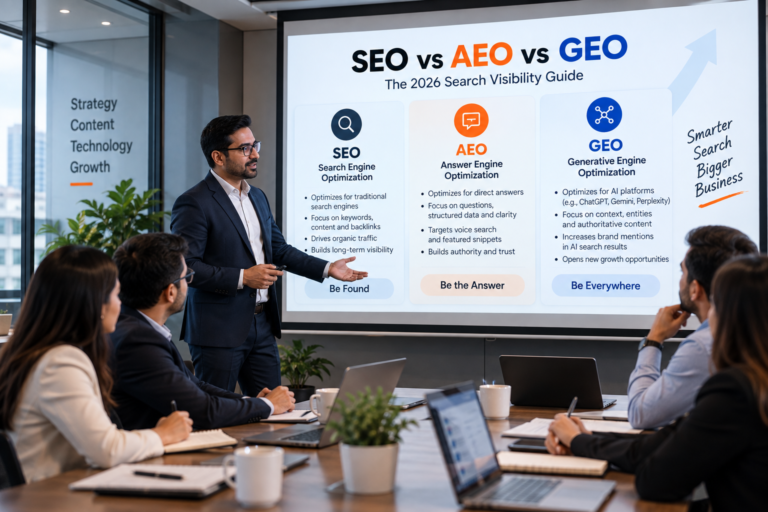
SEO helps people find your website in organic search. AEO helps your content answer real questions clearly. GEO helps make your business, expertise and evidence understandable across generative AI experiences. The strongest approach combines all three through one technically sound, useful and measurable content strategy.
SEO (Search Engine Optimization) improves how a website can be discovered, crawled, understood and shown in traditional organic search. It includes search intent, technical accessibility, useful content, internal linking, page experience and credible authority.
AEO (Answer Engine Optimization) is the practice of making content useful and easy to retrieve for question-and-answer experiences. It emphasizes clear definitions, direct responses, descriptive headings, examples and well-organized supporting information. It complements SEO; it does not guarantee a featured answer.
GEO (Generative Engine Optimization) focuses on whether generative search experiences can understand a business, its expertise and the context of its content. Practical work includes consistent entity information, original evidence, topic coverage, clear authorship and technically accessible pages. No provider can guarantee that an AI system will cite a particular page.
These terms describe useful strategic lenses. Google’s current guidance explains that AI features in Google Search continue to use its core Search systems and foundational SEO practices. It also says there are no additional technical requirements for inclusion in AI Overviews or AI Mode beyond being eligible to appear in Search.
SEO includes the work that helps search engines access and interpret your pages: crawlable architecture, indexable content, clear titles and headings, relevant internal links, useful media, page experience and reputable references. It also aligns pages with the intent behind a search—not just a keyword string.
AEO focuses on the questions buyers ask before they act. State the answer early, define technical terms, organize supporting details under meaningful headings and include examples or steps when they clarify the response. Do not write for snippets at the expense of completeness; the reader should be able to understand the answer without guessing.
GEO considers how generative systems may retrieve, summarize and cite information about a company or topic. Clear authorship, consistent entity details, original evidence, comprehensive topic coverage and accessible pages help reduce ambiguity. AI outputs change, so treat citations and brand mentions as outcomes to monitor—not placements you can promise.
The practical difference is the primary discovery experience each discipline addresses. Their activities overlap: one well-researched article can attract organic visits, answer a buyer’s question and provide useful source material for an AI-generated response.
| Area | Main purpose | Typical work | Useful measures |
|---|---|---|---|
| SEO | Improve organic search discoverability | Technical health, intent-led pages, internal links, content and authority | Search impressions, clicks, rankings, conversions |
| AEO | Make useful answers easy to identify and consume | Question-led sections, definitions, concise explanations and FAQs | Answer-surface visibility, qualified visits, assisted conversions |
| GEO | Improve brand understanding and potential visibility in generative answers | Entity clarity, original expertise, topical coverage and credible references | AI citations/mentions, referral visits, branded demand and leads |
These are planning categories, not three independent ranking systems. Metrics and reporting differ by platform.
People do not follow one fixed search path. A buyer might begin with a broad Google query, ask a detailed follow-up question, compare vendors in an AI assistant, check a company’s website and then search for reviews or proof. Your business needs to be understandable and useful at each stage—not simply visible for one keyword.
A connected approach also reduces duplicated work. One strong, evidence-led resource can support organic search, answer-focused discovery, internal links to service pages and informed sales conversations. The aim is consistent discoverability and trust, not publishing separate pages for every wording variation.
Build the strategy around customer questions and business outcomes. Start with a technically sound site, map topics to search intent, publish the most useful answer you can support, connect related pages and measure whether visibility produces qualified enquiries. The following sequence can be used by a small business or a larger B2B team.
DigiRankUp D-SAGE connection: our framework checks the full journey across search discovery, keyword intelligence, answer-first content, topical authority, entity clarity, internal and external authority, schema, technical SEO, conversions and performance intelligence. It is a quality-control framework—not a search-engine ranking formula.
Illustrative example only — not a DigiRankUp client case study. Imagine a B2B manufacturer that wants more qualified enquiries for a technical product. Its SEO work targets the product category and relevant commercial searches. Its AEO content explains specifications, compatibility, use cases and common buyer questions. Its GEO work makes the manufacturer’s identity, technical expertise, documentation and product information consistent and verifiable. The same evidence-led content supports all three discovery paths.
AI responses can vary by query, location, time and platform. Treat manual prompt checks and third-party visibility tools as directional observations, not as a universal ranking position. Google also documents a Generative AI performance report in Search Console for eligible Search and Discover AI-feature reporting.
Google’s generative AI guidance specifically cautions against unnecessary content chunking, inauthentic mentions and over-focusing on structured data for AI visibility. It recommends useful, original, people-first content and foundational SEO instead.
Continue building this topic cluster with these DigiRankUp resources:
At DigiRankUp, the D-SAGE approach brings search intent, answer-first content, topical authority, entity clarity, links, structured data, technical SEO, conversion and performance intelligence into one practical optimization process.
Bring SEO, AEO and GEO together with a clear plan for useful content, technical performance and qualified business growth.
DigiRankUp helps businesses improve digital visibility through SEO, Answer Engine Optimization, Generative Engine Optimization and website experiences built around customer intent. Our focus is practical strategy, credible content and measurable growth—not guaranteed rankings or shortcuts.
For ChatGPT Search, OpenAI identifies OAI-SearchBot as its search crawler. GPTBot is a separate crawler associated with potential foundation-model training, and the two robots.txt preferences are independent. Review the current crawler documentation and your own content-use preferences before changing robots.txt.