


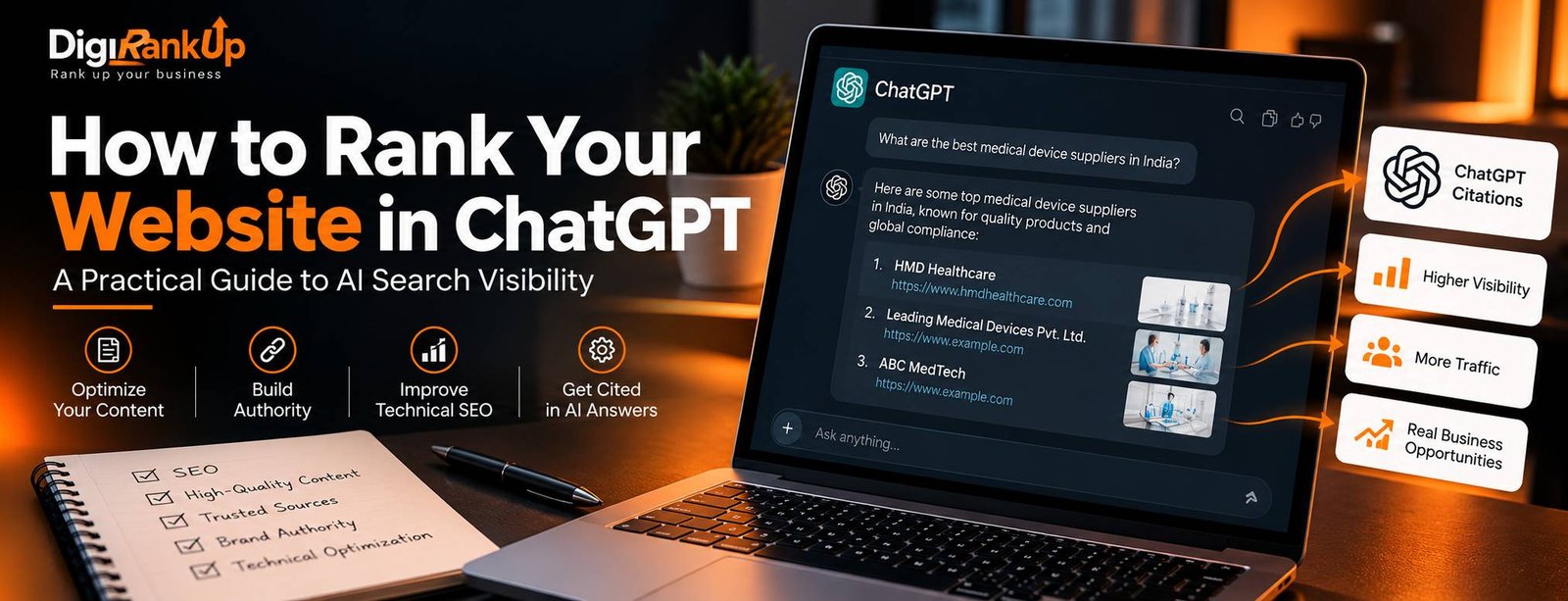
Many business owners search for “how to rank a website in ChatGPT” because they want their sites to appear in useful AI-generated answers. There is no guaranteed placement, but businesses can improve discovery readiness by making relevant pages accessible, useful, clear, and credible.
This guide explains practical steps to help your website become easier to discover and understand across AI-assisted search. It brings together technical accessibility, helpful content, brand authority, and measurement—without relying on supposed shortcuts or guaranteed-ranking claims.
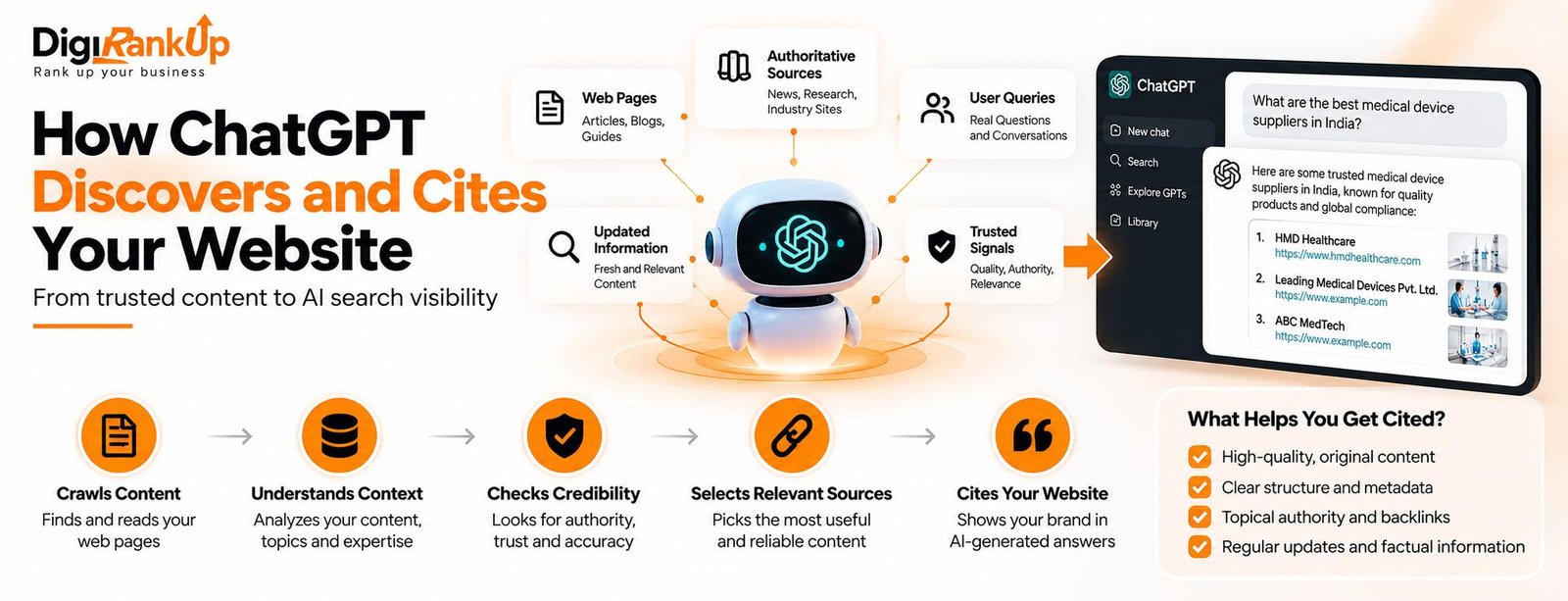
When people ask how to rank on ChatGPT, they usually mean getting a relevant website or brand mentioned, linked, or cited in an answer. Unlike a traditional search results page, ChatGPT responses can draw on different sources and may change depending on the query, context, and product experience.
There is no public, universal position that a website can guarantee. A more useful goal is to make your pages crawlable, relevant, accurate, easy to interpret, and worth referencing. For a broader overview, read DigiRankUp’s 10 Steps to Rank on ChatGPT: A Practical Guide to AI Visibility.
People increasingly use conversational tools to research questions, compare providers, and understand unfamiliar topics. When your website provides a genuinely useful answer, it may become one of the sources a user discovers during that process. Visibility can support awareness and referral visits, but it should be evaluated alongside qualified traffic, enquiries, and other business outcomes.
AI search optimization works best as an extension of a sound digital strategy—not as a replacement for traditional SEO, helpful service pages, reputation building, or a website that converts visitors.
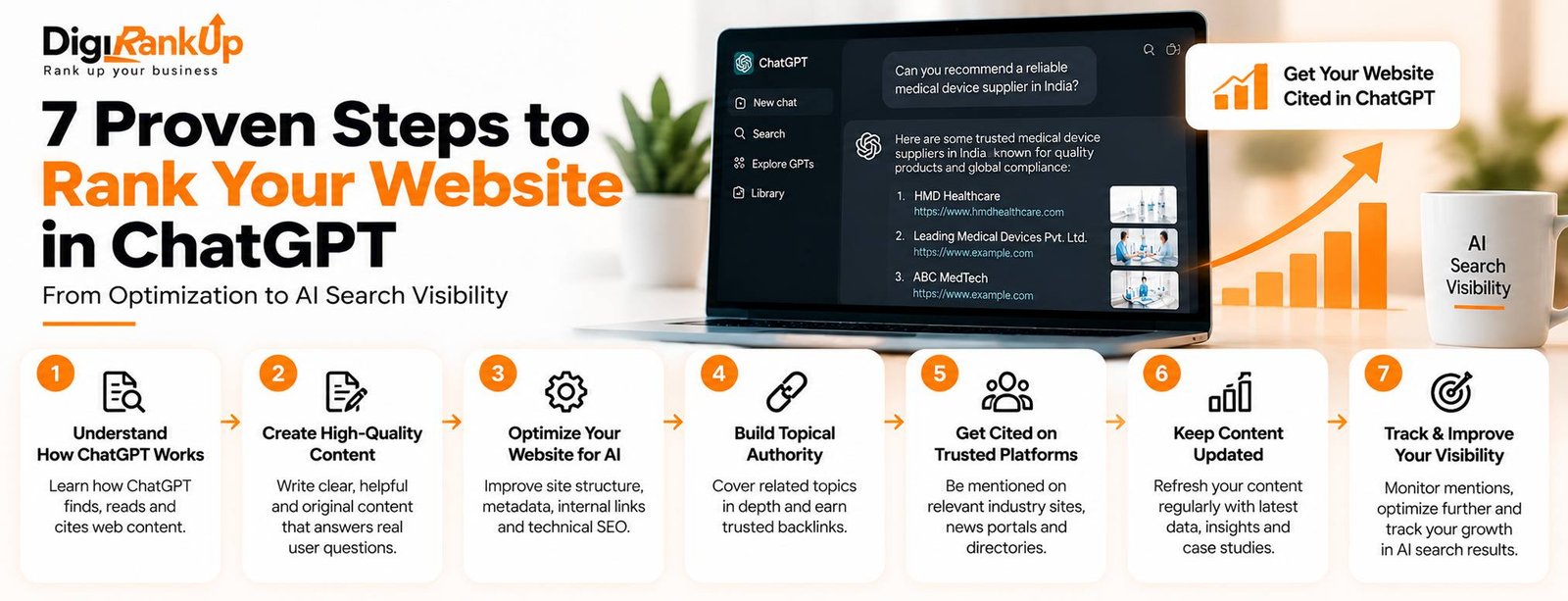
Review your robots.txt, firewall, and CDN rules to ensure that OpenAI’s OAI-SearchBot is not unintentionally blocked if you want your public pages to be eligible for ChatGPT search discovery. OpenAI documents OAI-SearchBot separately from GPTBot, which is used for a different purpose. Make crawler decisions deliberately and review the official OpenAI crawler documentation.
Ensure important pages return successful responses, use appropriate canonical URLs, and are not accidentally marked noindex. Maintain an XML sitemap, fix broken links and redirect chains, use HTTPS, and make key content available as readable text. Check Google Search Console and Bing Webmaster Tools for crawl or indexing issues.
Start relevant sections with a clear, direct answer, then explain the details. Use descriptive headings, concise paragraphs, numbered steps, and comparison tables when they genuinely help. This structure makes the page easier for people to scan and its information easier to interpret, though it does not guarantee a citation.
Go beyond generic summaries. Include real expertise, practical examples, trade-offs, original analysis, and transparent limitations. If you discuss pricing, performance, or statistics, verify them and explain the context. Content should solve the reader’s problem rather than merely repeat a target keyword.
Create a useful set of pages around the problems your audience needs to solve. For a business offering SEO, AEO, and GEO, this could include technical SEO, answer-focused content, structured data, AI crawler access, and measurement. Link related pages naturally so readers can move from a high-level explanation to a detailed guide. See also What Is GEO? A Complete Guide to Generative Engine Optimization and SEO vs AEO vs GEO: The 2026 Search Visibility Guide.
Keep your About, Contact, author, and service information accurate. Explain who is responsible for the content and why they are qualified to discuss the topic. Use genuine examples and case studies with permission, and distinguish real results from hypothetical illustrations. Avoid invented testimonials, credentials, or performance claims.
Build relationships with reputable industry publications, professional associations, partners, and useful resource sites. Earn coverage by contributing original research or expertise. Avoid spammy link schemes, bulk low-quality guest posts, and purchased promises of AI recommendations. The aim is a credible, consistent presence across sources relevant to your field.
Use a consistent business name, service description, contact information, and positioning across your website and legitimate third-party profiles. Where appropriate, maintain accurate company listings and author profiles. Consistency helps people verify what your business does and reduces confusion across the web.
Where relevant, use valid Schema.org markup such as Organization, Article, BreadcrumbList, or Service to describe visible page content. Test the markup and ensure it matches what readers can see. Structured data is a supporting technical practice—not a special switch that guarantees ChatGPT citations. Avoid irrelevant or misleading schema.
Choose a small set of realistic customer questions and test them periodically in ChatGPT. Record the exact query, date, response, and any cited sources; results can vary. Alongside these checks, monitor organic search performance, referral traffic, conversions, and qualified enquiries. Use the findings to prioritize improvements rather than treating individual AI answers as a fixed ranking report.
Use the same set of questions each time and record the date, wording, response, cited URLs, and whether your brand or a specific page appeared. Separate brand mentions from page citations and check that each cited source actually supports the answer. In analytics, identify known AI referral visits where possible and compare engagement, enquiries, and assisted conversions instead of relying on raw visits alone. Small samples can fluctuate, so review patterns over several weeks before making major changes. Prioritize pages with clear customer value and genuine content gaps; do not rewrite useful pages just because one test prompt did not mention your business.
| Timeframe | Priority | Actions |
|---|---|---|
| Week 1 | Technical access | Review crawler rules, sitemap, indexability, canonical URLs, and important errors. |
| Week 2 | Content quality | Improve two or three important pages with direct answers, helpful structure, and original detail. |
| Week 3 | Authority and links | Connect relevant articles, verify business information, and identify legitimate industry opportunities. |
| Week 4 | Measurement | Test representative questions and review search, referral, and conversion data. |
This is a starting plan, not a promise of results within 30 days. Discovery and citations depend on many factors outside a website owner’s control.
Make your public pages accessible, publish helpful and original content, strengthen technical SEO, demonstrate expertise, and build a credible online presence. These actions can improve discovery readiness, but they cannot guarantee that ChatGPT will mention or cite your site.
No. Traditional SEO supports discoverability and content quality, but ChatGPT may use different retrieval systems and sources. A high Google ranking does not guarantee a ChatGPT citation.
OAI-SearchBot is OpenAI’s crawler for discovering content used in ChatGPT search experiences. Website owners can review the official crawler documentation and their robots.txt or infrastructure settings to understand access.
SEO focuses on visibility in search engines, while Generative Engine Optimization focuses on making content useful and discoverable in generative AI experiences. They overlap in technical accessibility, helpful content, clear structure, and credibility.
No. Appropriate structured data can clarify page information for systems that use it, but it does not guarantee that a page will be retrieved or cited by ChatGPT.
There is no fixed timeline. Results depend on access, relevance, content quality, retrieval systems, and the question asked. Monitor progress over time and do not assume a specific publication date guarantees inclusion.
Improving your website’s chances of appearing in ChatGPT starts with the fundamentals: accessible pages, accurate information, genuinely helpful content, credible expertise, and a consistent measurement process. There is no guaranteed ranking formula, so focus on the improvements that make your site more useful to real customers.
For the companion checklist, read 10 Steps to Rank on ChatGPT: A Practical Guide to AI Visibility. Together, these resources provide a practical starting point for strengthening your AI search readiness.
DigiRankUp helps businesses strengthen their digital presence through SEO, AEO and GEO, website design, and portal development. If you want a practical plan for your website, visit DigiRankUp and get in touch to discuss your goals.
Editorial note: This article is educational and does not guarantee rankings, AI citations, leads, or business results. Always verify current platform documentation because search products and crawler behavior can change.